
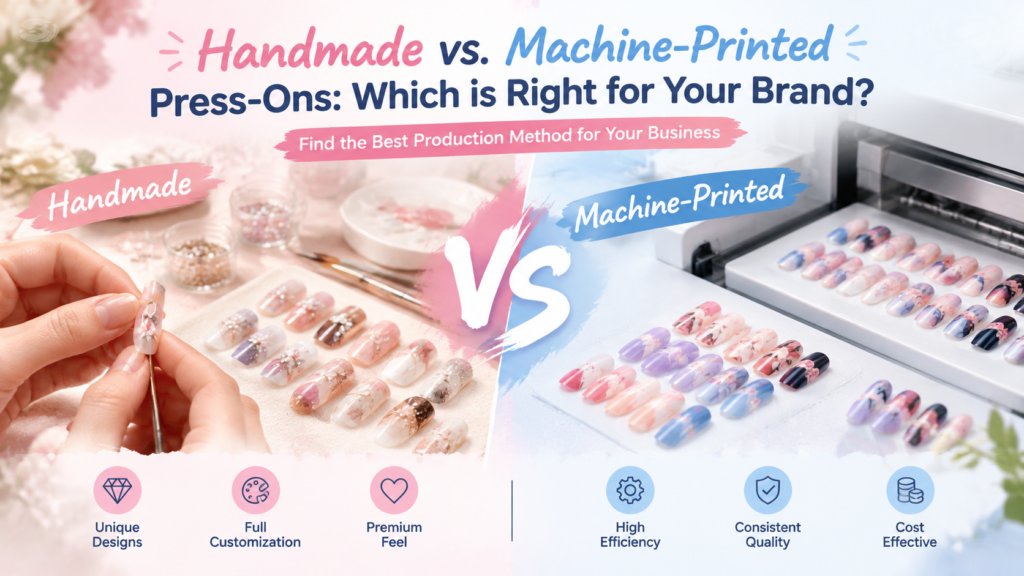
The global press-on nail market is experiencing an unprecedented boom. For beauty brand owners, salon entrepreneurs, and e-commerce retailers, adding press-on nails to your product catalog is a highly lucrative move. However, before you place your first bulk order, you face a critical strategic decision that will define your brand identity, profit margins, and customer retention: Should you source Handmade Gel Press-On Nails or Factory Machine-Printed Press-On Nails? [2]
Choosing between these two options isn’t just about price—it’s about matching your inventory with your target audience’s expectations. In this comprehensive guide, we will break down the structural differences, profit potentials, and brand positioning of both types to help you make the right wholesale investment. [2]
1. Defining the Core Technologies
Understanding how each product is constructed is key to justifying your retail prices to your B2C clients.
- Machine-Printed Press-Ons (Mass Production): These nails are manufactured using large-scale injection molding machines and high-speed industrial printers. The base is typically a standard ABS plastic tip, and the designs are printed directly onto the surface using UV ink or digital heat-transfer patterns.
- Handmade Gel Press-Ons (Premium Craftsmanship): These nails are built layer by layer by professional nail artists, replicating a luxury salon experience. The base is an premium, highly flexible soft-gel tip. Multiple layers of genuine gel polish, builder gel, top coat, and intricate 3D hand-painted designs are cured under a UV lamp for every single nail.
2. Head-to-Head Comparison for B_End Buyers
To help you weigh the operational and financial impact of both categories on your supply chain, we have summarized the core metrics below:
| Feature / Metric | Machine-Printed Press-Ons | Handmade Gel Press-Ons |
|---|---|---|
| Aesthetic Realism | Flat, printed, lacks depth or gloss | High-shine, 3D texture, looks like a $150 salon set |
| Material Flexibility | Stiff ABS plastic; prone to snapping or creasing | Flexible Soft Gel; bends but bounces back, fits snugly |
| Wholesale Cost | Ultra-low ($0.50 – $1.50 per box) | Premium ($4.00 – $12.00+ per box) |
| Retail Price Potential | Low-to-Mid ($8.00 – $15.00) | High Premium ($25.00 – $65.00+) |
| Profit Margin % | High (Low ticket, relies on mass volume) | Extremely High (High ticket, relies on premium value) |
| Minimum Order Qty (MOQ) | High (Usually 500–1,000+ sets per design) | Low-to-Flexible (10–50 sets per design) |
| Production Speed | Exceptionally fast (Millions of units/day) | Slower (Limited by artist capacity and curing times) |
3. Deep Dive into Value Metrics
🏢 Material and Durability: The Foundation of Customer Retention
The biggest complaint in the B2C press-on nail industry is when nails bend, crease, or break within 48 hours.
- Machine-Printed nails are made from rigid plastics. If a customer hits their nail against a hard surface, the plastic creases, creating an unsightly white line, or it snaps entirely.
- Handmade nails utilize soft-gel bases fortified with professional builder gels. They possess an inherent elasticity that contours perfectly to the natural curvature of the client’s nail bed, providing a lightweight feel and lasting up to 3–4 weeks with proper adhesive.
🎨 Design Intricacy: Setting Your Brand Apart
- Digital printers struggle with textures. If your brand wants to sell cat-eye effects, chrome finishes, 3D embossed flowers, rhinestone clustering, or jelly glass gradients, machines simply cannot replicate them authentically.
- Handmade sets excel at luxury artistic trends. Every gemstone is anchored with strong industrial jewelry gel, and the multi-layered gel application creates a distinct salon-grade “plumpness” and high-gloss shine that makes them indistinguishable from acrylic extensions.
📈 Capital Allocation and MOQ Flexibility
- For startup brands or salons testing the waters, Handmade nails offer an incredible shield against dead stock. Because they are crafted by teams of artists rather than massive industrial molds, suppliers can offer low MOQs. This allows you to test 20 different high-end designs with minimal capital.
- Machine-Printed configurations require large, continuous factory runs. If a design doesn’t sell, you are left holding hundreds of units of unmovable inventory.
4. Strategic Alignment: Which One Fits Your Brand Identity?
🛒 Scenario A: Choose Machine-Printed Nails if…
Your brand operates on a high-volume, fast-fashion retail model. You sell primarily on Amazon, TikTok Shop, or low-cost drugstores. Your target demographic consists of teenagers, budget-conscious college students, or impulse buyers who view press-on nails as a single-use accessory for a single weekend event. Your marketing focus is on low prices and massive design variety.
💎 Scenario B: Choose Handmade Gel Nails if…
Your brand is positioned as a luxury cosmetic line, an upscale independent boutique, or a premium nail salon. Your target customers are busy professional women, bridal parties, and beauty enthusiasts who value time, comfort, and premium aesthetics. They gladly spend $40+ for a reusable, zero-damage solution that saves them a 2-hour salon trip.
Partner with a Trusted B_End Supply Chain
At [chicpresstips], we specialize in providing certified, high-grade wholesale supply chains for both mass-market machine-printed lines and luxury handmade gel collections. Our production facilities implement strict multi-stage quality control to guarantee that your brand enjoys high margins, low return rates, and unwavering customer loyalty.
