Every beauty store and boutique owner knows that retail shelves represent premium real estate. When salon managers attempt to scale their passive income, a recurring dilemma surfaces: how to price press on nails for retail without alienating budget-conscious regulars or undermining professional luxury service values?
Pricing is not a guessing game; it is an economic strategy. If you anchor your retail pricing floor solely on cheap online retail platforms, you destroy your perceived value. Conversely, pricing blind can stagnate quarterly turnover. Below is a raw, numbers-driven strategic breakdown designed to help you balance margins, maximize inventory velocity, and optimize counter profits.
The Foundation: Your Cost of Goods Sold (COGS) Formula
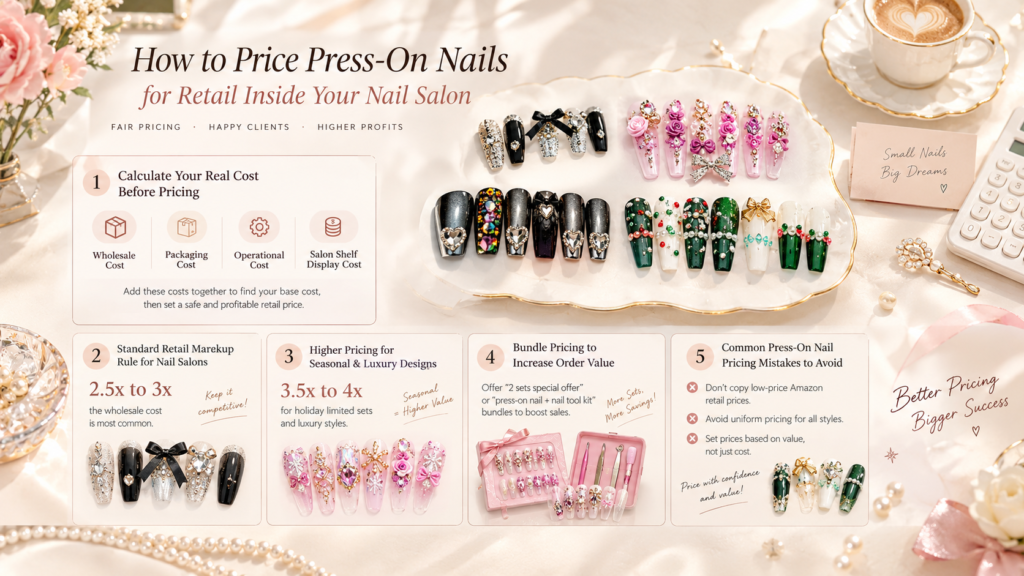
Before applying any industry markups, you must establish an airtight foundation. Most salon owners experience thin margins because they calculate basic procurement but forget invisible operational drains. To fully grasp how to price press on nails for retail, you must utilize a comprehensive cost accumulation formula:
\(\text{True\ COGS}=\text{Base\ Wholesale\ Price}+\text{Packaging\ Customization\ Cost}+\text{Inbound\ Freight\ per\ Unit}+\text{Display\ Space\ Overhead}\)
Never omit shipping fees or the costs of complimentary application toolkits (glue, adhesive tabs, files). If a premium handmade or luxury private label set costs $6.50 to arrive at your storefront, and the custom box adds $1.00, your actual starting point is $7.50, not $6.50.
Tiered Progression: The 3-Tier Salon Retail Matrix
Instead of a flat-rate price across your entire catalog, implementing a structural tiered matrix accommodates diverse consumer buying mentalities while capturing maximum consumer surplus.
Tier 1: The Essential Core (The Volumizer)
- Target Styles: Basic solid colors, classic glossy topcoats, and standard short round/square shapes.
- The Pricing Logic: 2.5x Markup. These are your impulse-buy items meant for fast turnover.
- Optimal Retail Range: $15.00 – $19.00 (Assuming a true landing cost of $6.00–$7.50).
Tier 2: The Trendsetter (The Profit Anchor)
- Target Styles: Trendy medium almond lengths, chrome overlays, cat-eye effects, and seasonal pastel French tips.
- The Pricing Logic: 3x to 3.5x Markup. These mirror current social media aesthetics that clients desperately crave.
- Optimal Retail Range: $22.00 – $29.00.
Tier 3: The Editorial Luxury (The Image Builder)
- Target Styles: Extravagant long coffin silhouettes, hand-painted 3D crystal charms, and detailed holiday-limited collections (e.g., Halloween/Christmas editions).
- The Pricing Logic: 4x Markup. These serve as salon station showstoppers that prove your elite design curation.
- Optimal Retail Range: $35.00 – $48.00.
Value Architecture: Moving Beyond Single-Set Sales
If your counter display only features single-item transactions, you are leaving massive passive income on the table. To artificially inflate your Average Order Value (AOV), restructure how your inventory is presented at checkout through bundled value architecture.
Strategy A: The “Full Service” System Bundle
Do not just sell a single set of wear-ons. Create a curated package: A premium seasonal nail set paired with a luxury custom travel storage case, an organic cuticle oil pen, and a professional-grade dehydrator pad. Package this as a comprehensive $45 luxury kit. It reframes the purchase from a “temporary alternative” into a high-end, self-care experience.
Strategy B: The Multi-Occasion Rotation
Bridge the gap between regular salon appointments by selling rotation bundles. Market a “Weekend Trio Pack” allowing clients to mix-and-match three diverse styles—one professional nude for the office, one vibrant chrome for weekend travels, and one classic holiday release—for a fixed price of $65. This structure clears slower-moving SKU lines rapidly without sacrificing your brand’s core premium image.
Deconstructing the 3 Most Fatal Pricing Pitfalls
To defend your bottom line against market dilution, your management must audit and eliminate these three commercial vulnerabilities immediately:
- The Race to the Bottom: Competing directly on price with mass-market plastic extensions sold on global e-commerce discount platforms. Your clients pay for immediate physical availability, professional aesthetic vetting, and salon-grade ABS durability. Price like a luxury boutique, not a discount warehouse.
- Ignoring the Custom Packaging Leverage: Selling elite, high-margin nails inside standard blank cellophane bags. Unbranded presentation forces consumers to evaluate the product based on plastic raw material rather than fashion status. Custom branded box packaging justifies a 40% retail markup increase effortlessly.
- Static Display Overdue: Leaving unsold spring pastel inventories on display during the peak of winter dark-glamour demands. Stagnant displays tell customers your stock is outdated. Constantly cycle your visual merchandise to maintain urgency.
Securing the Supply Chain to Support Your Matrix
Ultimately, mastering how to price press on nails for retail is entirely dependent on the strength and efficiency of your upstream manufacturing supply chain. To comfortably execute a 3x or 4x retail markup while guaranteeing break-resistant durability to your end-users, you require a reliable wholesale factory partner. Securing a supplier that delivers strict structural quality control, low MOQ customized packaging solutions, and rapid international logistics allows your salon business to maintain incredibly low inbound costs. This foundational supply stability gives your brand the maximum retail flexibility needed to scale profit margins and dominate your local beauty market.
