The global press on nail market is experiencing an unprecedented boom. For beauty brand owners, salon entrepreneurs, and e-commerce retailers, adding press-on nails The global wear-on manicure market is experiencing an unprecedented boom. For beauty brand owners, salon entrepreneurs, and e-commerce retailers, adding nail extensions to your product catalog is a highly lucrative business move. However, before you place your first bulk commercial order, you face a critical strategic decision that will define your brand identity, profit margins, and customer retention: Should you source high-end custom press on nails or mass-produced, machine-printed alternative collections?
Choosing between these two options isn’t just about the initial procurement price—it’s about matching your wholesale inventory with your target audience’s luxury expectations. In this comprehensive B2B comparative guide, we will break down the structural differences, operational costs, and brand positioning of both types to help you make the right investment.
Defining the Core Manufacturing Technologies
Understanding how each category is physically constructed is key to justifying your retail prices to your end consumers.
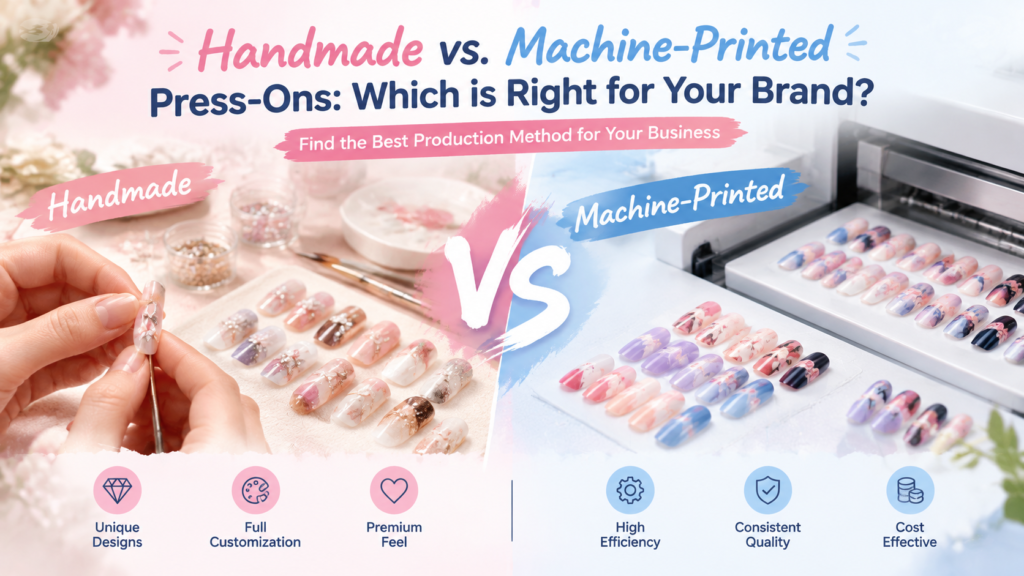
- Machine-Printed Press-Ons (Mass Production): These nails are manufactured using large-scale injection molding machines and high-speed industrial printers. The designs are printed directly onto standard plastic surfaces using UV ink or digital heat-transfer patterns. They are uniform, cheap to produce, but often look flat, synthetic, and suffer from pixels or blurry detailing up close.
- Handcrafted Gel Press-Ons (Artisan Craftsmanship): Often marketed as premium custom press on nails, these extensions are built layer by layer by professional nail artists, replicating a premium salon experience. The base is an elite, highly flexible soft-gel tip. Multiple layers of genuine gel polish, builder gel, rhinestones, and intricate 3D hand-painted designs are cured under a UV lamp for every single nail, yielding breathtaking, premium textures.
Head-to-Head Comparison for Beauty Buyers
To help you weigh the financial and operational impact of both product lines on your retail supply chain, we have broken down the core metrics below:
- The Profit Margin Potential: Machine-printed sets have a very low retail ceiling, forcing brands into a fierce price war with cheap online platforms. Handcrafted custom sets support high-end boutique pricing ($30 to $55+ per box), unlocking massive retail flip margins and establishing your store as a premium fashion destination.
- Design Flexibility and Exclusivity: Printers are restricted by 2D digital patterns and flat surfaces. Manual artisans can execute infinite texture variations, including metallic chrome streaks, holographic cat-eye shifting effects, 3D sweater patterns, and heavy crystal charms that machines simply cannot duplicate.
- Structural Durability and Fit: Cheap plastic blanks crack or whiten easily under daily lifestyle pressure. Premium custom sets leverage tapered cuticle edges and reinforced polymer tips, allowing the end user to safely reuse the nails multiple times without structural deformation or edge chipping.
Strategic Brand Positioning: Mapping Your Matrix
The ultimate decision between these two supply chains relies completely on your target buyer persona and overarching retail monetization blueprint.
Scenario A: The High-Volume Mass Market Retailer
If your retail model targets high-volume distribution, fast-fashion impulse buyers, or budget-conscious teenagers, machine-printed sets are a functional choice. The low cost per unit allows you to maintain low price points on retail racks, making them excellent options for large-scale beauty supply chains or promotional giveaway bundles.
Scenario B: The Luxury Boutique and High-End Nail Salon
If you currently own an upscale physical salon, a spa, or an online DTC brand aiming for maximum customer retention, you should invest exclusively in professional custom press on nails. Your clients expect exceptional aesthetics that look indistinguishable from a hours-long acrylic manicure. Offering handmade sets at your front checkout counters provides immediate glamour for their travels, protects your brand reputation, and drives incredible passive profit without adding local technician labor stress.
Avoiding the Common Catalog Pitfall
Many new brand founders make the fatal mistake of mixing high-end artisan marketing with low-grade machine-printed products inside unbranded packaging. When consumers pay a premium but receive flat, pixelated plastic nails, their brand loyalty drops instantly. If you market your products as a premium alternative to traditional manicures, your material quality, gel depth, and architectural shape consistency must strictly match that luxury claim.
Partner with the Elite Wholesale Supplier for Success
Ultimately, building a highly profitable luxury brand depends entirely on the stability and quality of your upstream manufacturing supply chain. Launching your collection of custom press on nails is only effective when you partner with a factory that understands international salon standards.
