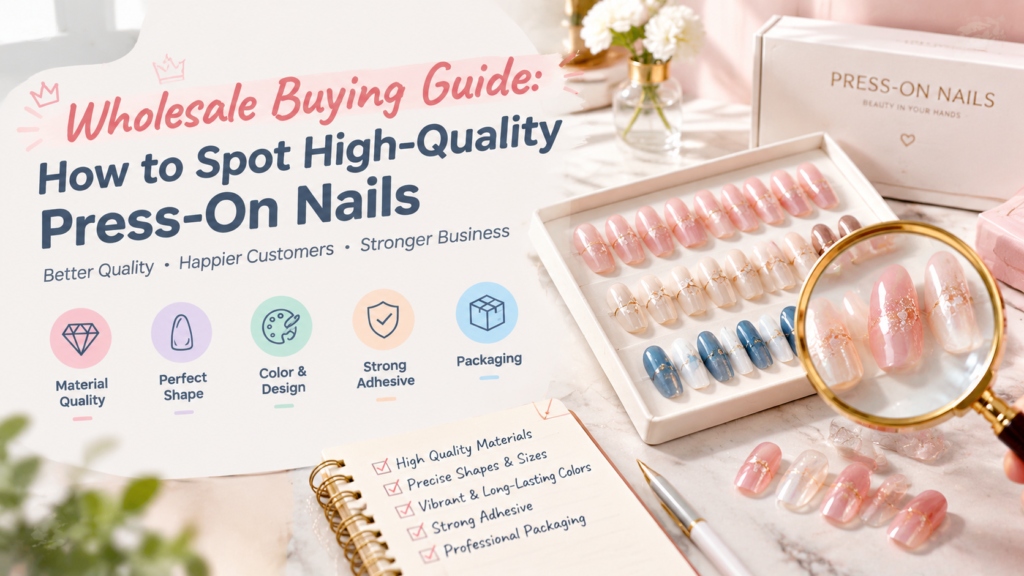
The global press-on nail market is hyper-competitive. As a wholesale buyer, salon owner, or cosmetic brand founder, your long-term business turnover relies entirely on repeat customer retention and five-star customer reviews. However, sourcing premium press-on nails from overseas manufacturing hubs can frequently feel like a high-stakes gamble. Thousands of digital suppliers offer visually identical product catalog photos, yet their bulk pricing ranges vary wildly.
In the commercial B2B landscape, buying the cheapest alternative often costs significantly more in the long run due to high customer return rates, terrible bad reviews, and permanent brand reputation damage. How can your business separate luxury, salon-grade stock from cheap, flimsy plastic blanks? In this official wholesale buying guide, we reveal the exact industry chemical benchmarks, manual stress tests, and structural details to look for when learning how to spot high quality press on nails before placing a major commercial order.
The Dual-Track Material Vetting: Soft Gel vs. Rigid ABS Plastic
The definitive foundation of a premium wear-on nail lies inside its core chemical composition. When requesting raw factory samples from a new manufacturer, you must test the flexibility, structural bounce-back memory, and apex density of the nail tip blanks.
Low-Tier Mass Market Plastics typically utilize 100% rigid ABS or brittle polystyrene sheets. If you press down firmly on the center of the tip to bend it, the cheap plastic creases instantly, leaving an unsightly white structural stress line, or stays permanently bent out of shape. The commercial risk here is devastating. These nails crack and snap easily during daily physical activities like typing or heavy working. Salon clients will complain that the extensions feel brittle, heavy, and synthetic.
Premium Salon-Grade Polymers leverage high-molecular-weight PMMA, soft-gel, or reinforced flexible resins. When learning how to spot high quality press on nails, the bend test is your ultimate weapon. A high-quality flexible tip will bend smoothly under intense finger pressure and instantly bounce back to its original tailored silhouette with zero white lines, stress clouding, or structural micro-cracks. This advanced material selection contours comfortably to the user’s natural finger curve, provides a lightweight wear-on experience, and absorbs daily impacts seamlessly.
Step-by-Step Benchmarking: The 3 Crucial Laboratory Stress Tests
To protect your inventory from dead stock, your procurement team should subject every factory sample set to three physical tests.
Test 1: The Cross-Hatch Topcoat Friction Check
Many suppliers use cheap industrial inks that chip or peel within days. Take a professional file or a sharp metal edge and gently cross-scratch the surface of a finished custom nail. Premium custom manufacturers apply a heavy-duty, UV-cured gel topcoat over hand-painted colors. If the gloss coat or art detailing flakes off immediately under minimal friction, the factory skipped proper chemical curing. High-quality coats absorb heavy friction while locking in a brilliant, mirror-like shine for up to 3 weeks.
Test 2: The Embellishment Leverage Pull
Intricate 3D rhinestone art, holographic cat-eye shifting effects, and holiday-themed crystal charms generate your highest profit margins. Use your thumb to apply firm lateral pressure to a crystal charm on the sample nail. Low-tier factories apply cheap glue that pops off under pressure. Premium workshops encapsulate the structural roots of every rhinestone manually inside a thick layer of builder gel. This keeps the decorations permanently locked in place even during intense daily workouts.
Test 3: The Tapered Cuticle Indexing Audit
Examine the back edge of the faux tip where it meets the client’s skin. Cheap injection-molded blanks have identical thicknesses from the tip to the cuticle. This thick edge creates a massive step that snags hair and causes premature lifting. Professional artisan extensions feature an ultra-thin, micro-tapered cuticle edge that flushes seamlessly against the skin, paired with a robust, thickened apex to handle daily pressure.
Navigating the Wholesale Purchasing Matrix
Your ultimate brand positioning and monetization matrix depend entirely on sourcing consistency. Mixing high-end pricing with low-grade brittle plastic results in a collapse of customer retention.
For businesses targeting high-spending salon regulars or premium DTC e-commerce collectors, you must educate your internal supply buyers on how to spot high quality press on nails. Partner with an elite manufacturer that delivers strict quality control protocols, low MOQ (Minimum Order Quantity) customized packaging boxes, and rapid international shipping logistics to keep inbound landing costs low.
Securing an airtight supply chain gives your brand the ultimate pricing flexibility needed to implement standard 3x markups, satisfy local beauty boutique owners, and dominate the modern fashion retail marketplace effortlessly.
